

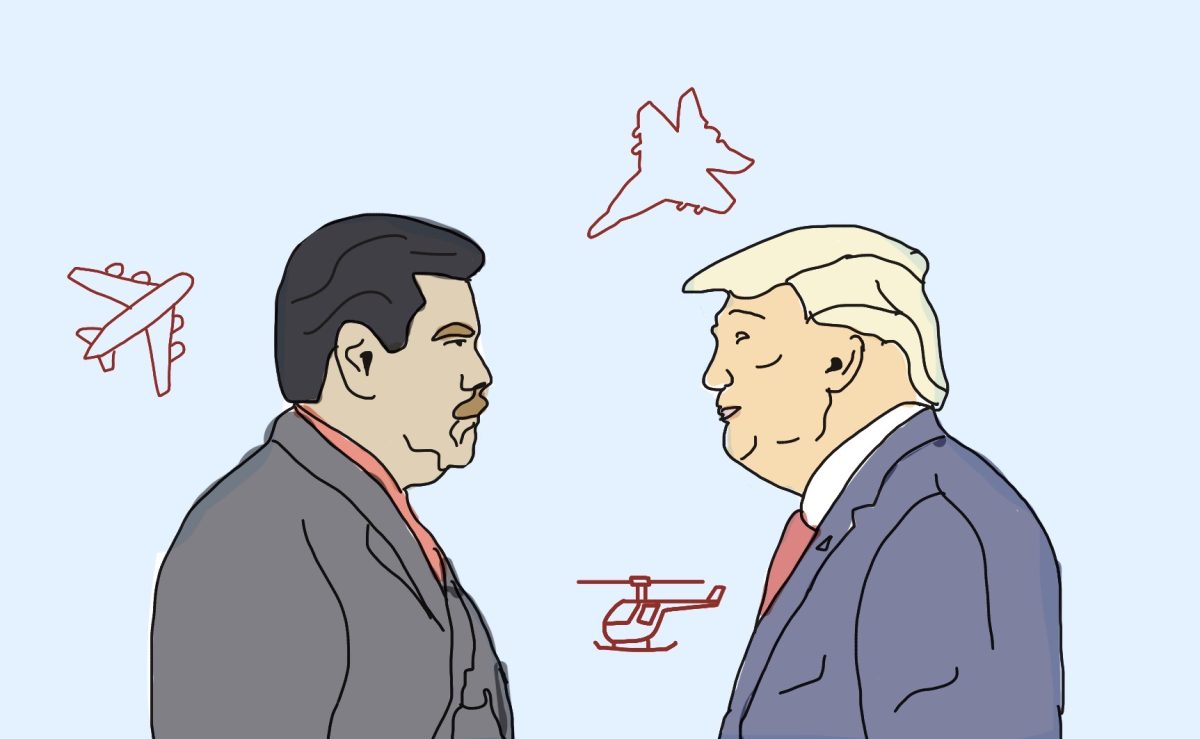
Three days after celebrating the new year, Americans woke up Saturday morning to a message from the president: the U.S had attacked Venezuela and captured its president.
On January 3rd, at around 2 a.m, 150 U.S aircrafts flew into Venezuela and seized President Nicolás Maduro and his wife, transporting them to the U.S. The operation resulted in 7 U.S injuries and over 100 Venezuelan military fatalities. President Trump titled Operation Absolute Resolve as a success for America.
“Overwhelming American military power, air, land, and sea was used to launch a spectacular assault, and it was an assault like people have not seen since World War II…This was one of the most stunning, effective, and powerful displays of American military might and competence in American history…No nation in the world could achieve what America achieved yesterday or, frankly, in just a short period of time,” President Trump said in a public address shortly after the attack.
While the attack came as a shock to Americans and the majority of Congress itself, President Trump had been preparing U.S troops for months prior to the operation. Maduro himself was aware of the tensions that had been simmering between Venezuela and the U.S.
“Trump has openly flirted with the idea of regime change in Venezuela. In late November, Trump gave Maduro an ultimatum to relinquish power, offering him safe passage out of the country. Maduro refused the offer, telling supporters in Venezuela that he did not want ‘a slave’s peace and accusing the US of wanting control of his country’s oil reserves,’” The Guardian stated in an article recapping the past few days.
In Saturday’s news conference, Trump named Maduro’s involvement in drug trafficking and importation of cocaine into the U.S as the primary reasons for Maduro’s capture. He also stated that American oil companies would take control and administer the oil production in Venezuela, claiming that the “biggest beneficiary” were going to be the “people of Venezuela.”
Maduro has been president of Venezuela since 2013, where he came to power through a rigged election. Since then, 8 million Venezuelans have fled the country because of the unstable democracy and poor living conditions. 82% of Venezuelans live in poverty and many don’t have access to safe drinking water.
“‘He’s a brutal dictator who imprisons people who think differently and who oppose him. He’s a dictator who oversaw the biggest economic collapse in modern Latin American history and is responsible for the largest exodus of migrants in the hemisphere’s history. And he is someone who has constructed a shameful legacy,’” author John Polga-Hecimovich said in a The Guardian article.
Many Venezuelans are thrilled by Maduro’s detainment. Others have mixed reactions. The Conversation, a journalistic non-profit organization, interviewed Venezuelans during a celebration of the news in Madrid.
“‘… I am happy Maduro’s going to be in jail, but I know the repercussions. I know what a war means… ‘I just want my family to be safe. I just want the simple things. I can’t celebrate until I know my family is safe,’” a Venezuelan woman said in The Conversation’s interview.
Venezuelans aren’t the only ones who are worried about the events that will follow the capture. Many Americans and lawmakers debate whether or not Trump’s attack was constitutional, since Trump did not receive congressional approval for the operation. In fact, many lawmakers were kept in the dark until the attack happened. According to the TIMES Magazine, 36% of adults approved of the strike, 39% opposed it and 25% were unsure how they felt.
“One thing is clear: Trump’s bombing and regime-decapitation operation in Venezuela was unconstitutional. The Constitution gives Congress, not the president, the power to decide when, where, and against whom the United States goes to war. It’s a core part of our system of checks and balances — and for good reason,” Michael Waldman, president of Brennan Center for Justice said in an article.
Supporters of the operation, however, argue that congressional approval wasn’t required because it was a “targeted mission,” not an invasion with extended military concentration.
“It’s just not the kind of mission that you can pre-notify (Congress about) because it endangers the mission,” Secretary of State Marco Rubio stated in Saturday’s press conference.
Currently, Maduro is being detained in a New York jail, where he awaits further legal action. According to the U.S Department of State, prosecutors charged Maduro on counts of “narco-terrorism, conspiracy to import cocaine, possession of machine guns and destructive devices and conspiracy to possess machine guns and destructive devices.”
Beyond Maduro’s detainment, many Americans are uncertain of Trump’s plan for the immediate future of Venezuela.
“We are left with no understanding of how the administration is preparing to mitigate risks to the U.S. and we have no information regarding a long-term strategy following today’s extraordinary escalation,” Senator Jeanne Shaheen spoke on the issue.
According to PBS News, “In a Jan. 3 press conference at Mar-a-Lago, Trump said the U.S. would “run the country until such time as we can do a safe, proper and judicious transition.”